

IPSec 重协商机制
IPSec 重协商机制
SA 到期时间
FortiGate 的 IPSec 关于 SA 的到期时间,有两个相关的时间概念:
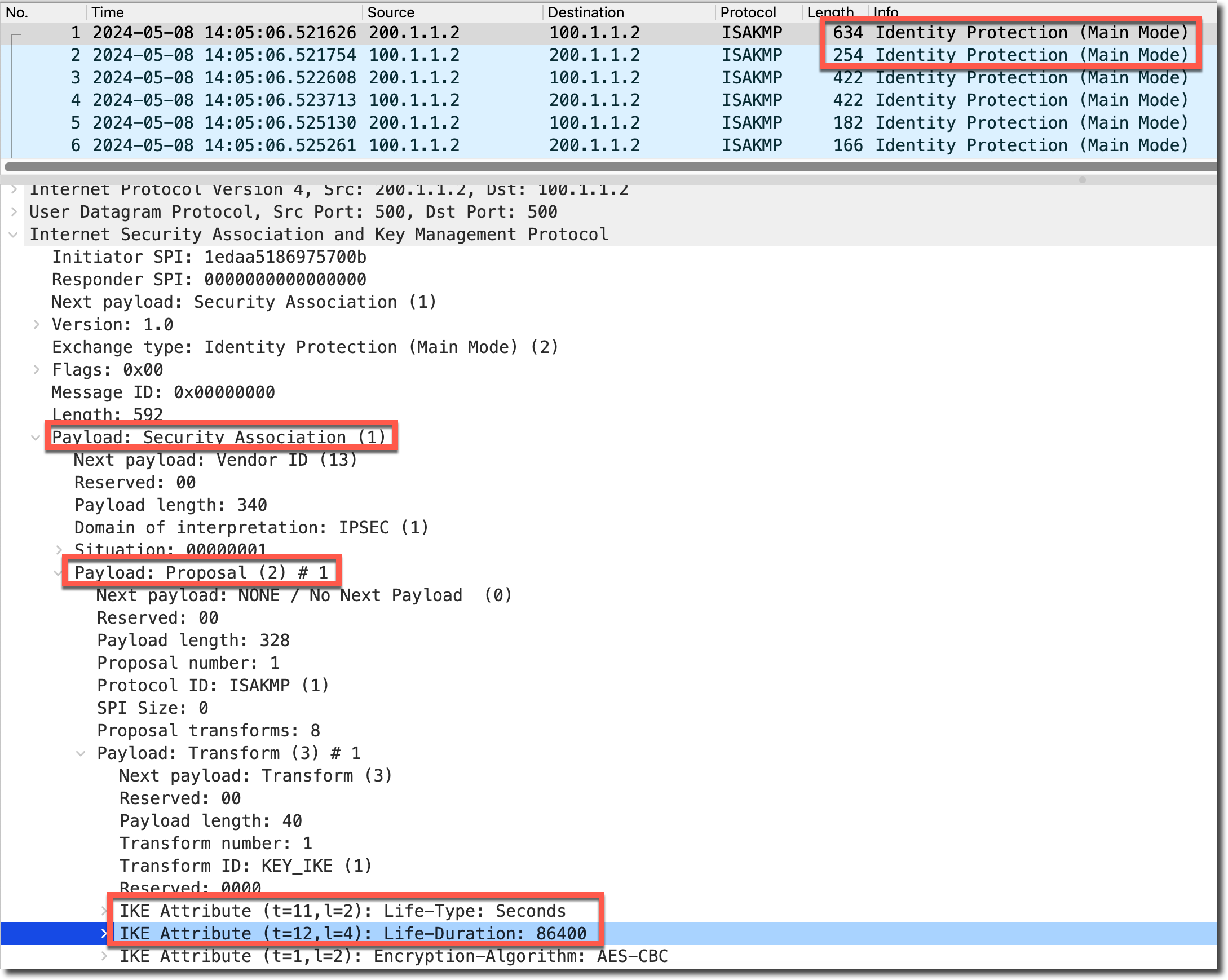
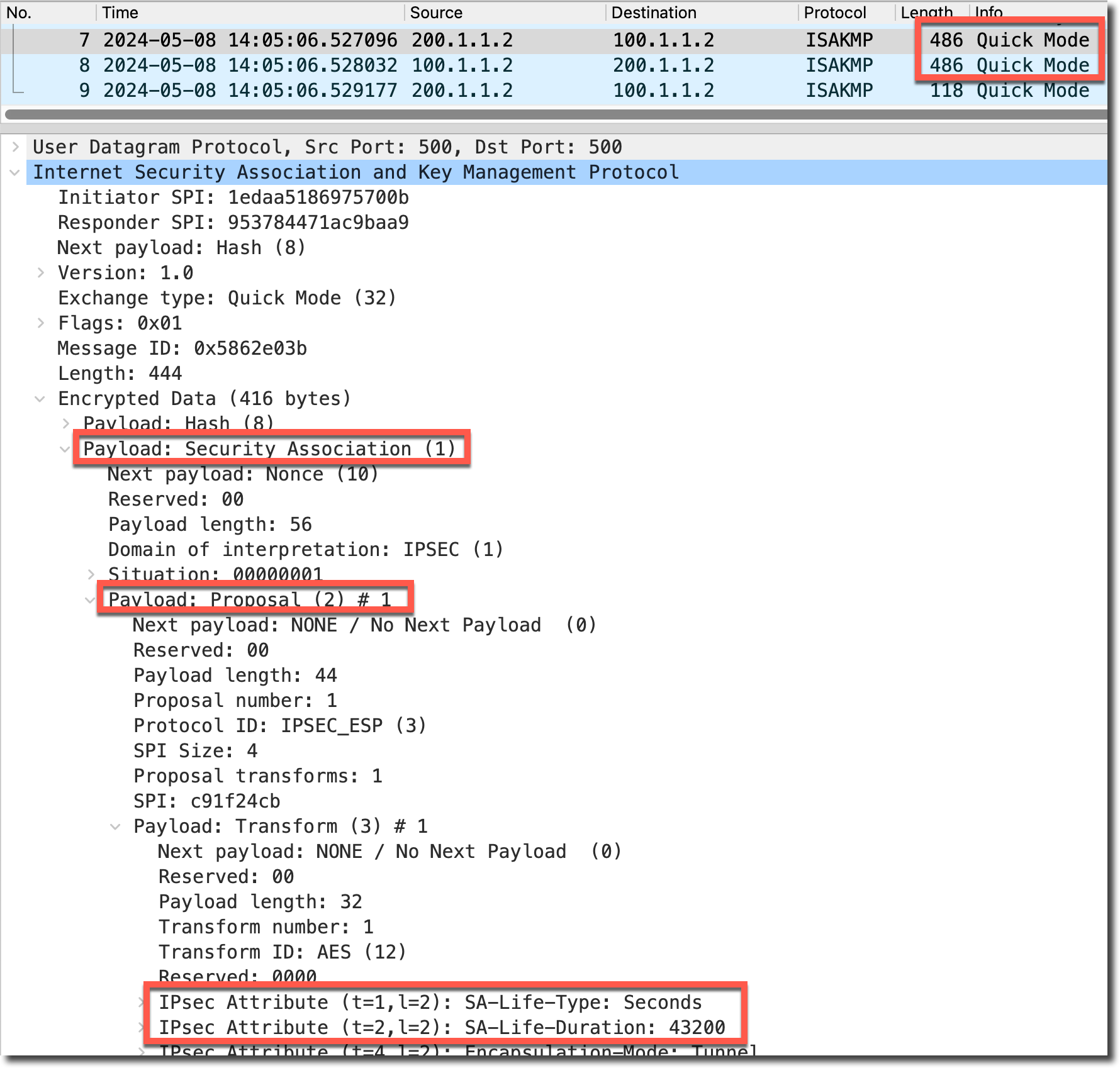
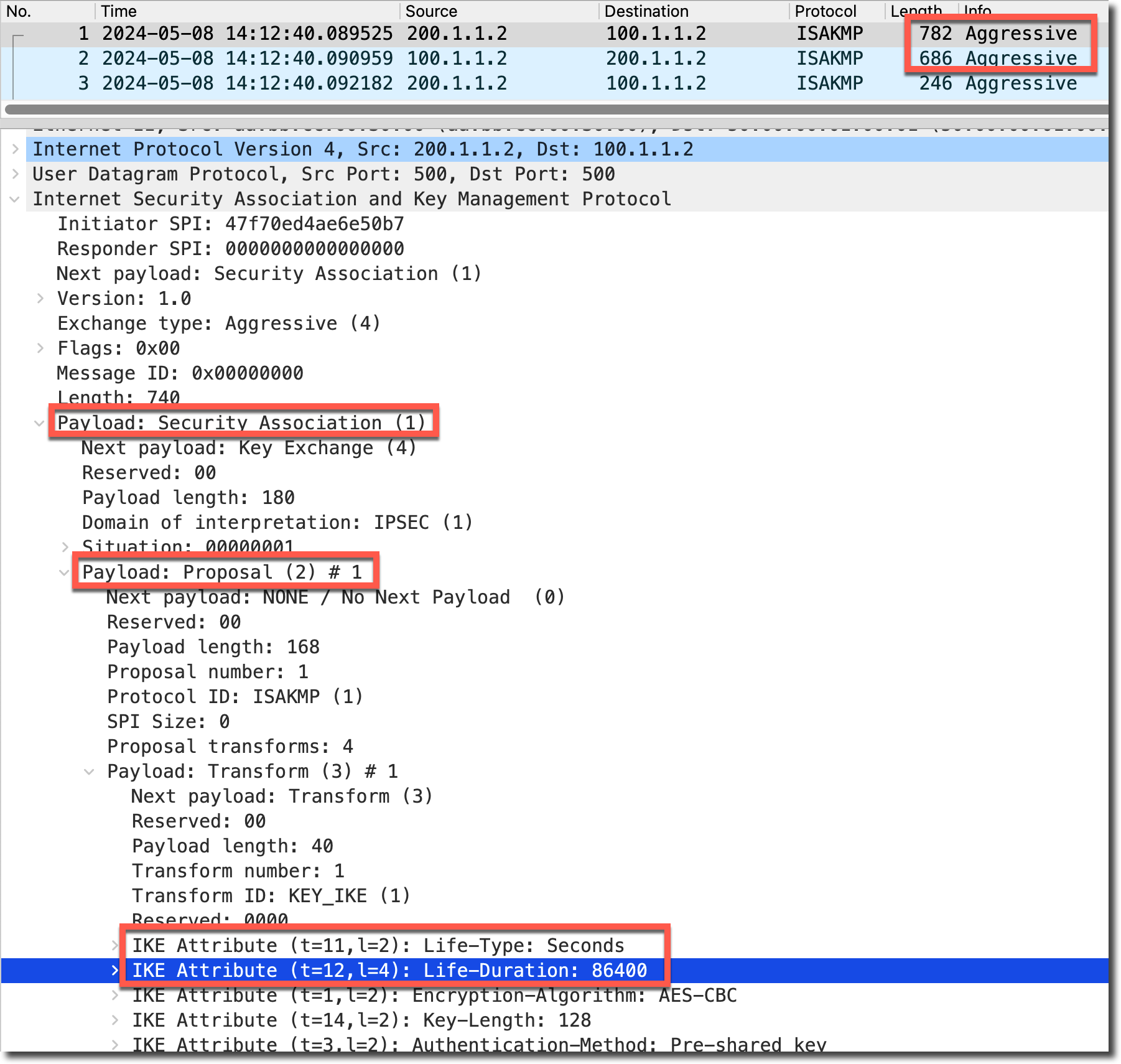
hard-timeout: 在 IPSec 的一阶段和二阶段中,均可以配置重协商超时时间(lifetime,下文我们用 hard-timeout 来表示配置的 lifetime)。当 hard-timeout 到期后,FortiGate 将结束当前一阶段/二阶段的 SA。hard-timeout 表示每一个一阶段/二阶段 SA 在本地的最大存在时间。默认配置下,FortiGate 的 IPSec 一阶段重协商(hard-timeout)超时时间为 86400s(24 小时),二阶段重协商(hard-timeout)超时时间为 43200s(12 小时)。
soft-timeout: 实际的重协商间隔时间会小于 hard-timeout,被称为 soft-timeout。soft-timeout 总是小于 hard-timeout。在 hard-timeout 到期前,FortiGate 会发起新的一阶段/二阶段协商并形成一对新的 SA。同时,旧的一阶段/二阶段 SA 直到 hard-timeout 到期时才会消失,在(hard-timeout - soft-timeout)这个时间差(rekey-margin)内,会存在两对 SA。soft-timeout 是一种平滑机制,保证在旧 SA 的 hard-timeout 到期前协商出新的 SA。在旧 SA 与新 SA 交替的过程中,IPSec 业务不会中断。如果在 SA 的 hard-timeout 到期时才重协商新的 SA,那么会导致 IPSec 业务在重协商期间中断。
重要
soft-timeout rekey 机制需要在 IPSec 二阶段中开启
keepalive功能才能生效,详情请参考:VPN → IPSec VPN → 自动协商与 keepalive 章节。
hard-timeout 交互
在 IPSec 一阶段/二阶段协商交互报文中,会携带已配置的重协商时间:
IKEv1 主模式:
一阶段,位于第 1、2 个协商报文中:
二阶段,位于第 1、2 个协商报文中:
IKEv1 野蛮模式:
一阶段,位于第 1、2 个协商报文中:
二阶段:与 IKEv1 主模式相同,位于第 1、2 个协商报文中。
IKEv2:FortiGate 一阶段/二阶段协商时不携带 hard-timeout 参数。
hard-timeout 协商
IKEv1
如 hard-timeout 交互章节所示,IPSec IKEv1 协商的双方会交互 hard-timeout 参数。但并不会因为双方配置的 hard-timeout 不一致而导致协商失败。当 IPSec IKEv1 协商的双方配置的一阶段/二阶段 hard-timeout 不一致时,两端 IPSec 应以 IPSec 协商双方配置的较小的 hard-timeout 为准。如下示例:
FW1 与 FW2 之间建立 IPSec IKEv1(主模式或野蛮模式)连接,FW1 配置 IPSec 的一阶段/二阶段协商时间为 3600s/1800s,FW2 配置 IPSec 的一阶段/二阶段协商时间为 1800s/3600s。
FW1:
config vpn ipsec phase1-interface
    edit "to_FW2"
        set interface "port2"
        set keylife 3600    <----一阶段hard-timeout
        set net-device disable
        set remote-gw 201.1.1.2
        set psksecret xxxxxx
    next
end

config vpn ipsec phase2-interface
    edit "to_FW2"
        set phase1name "to_FW2"
        set keylifeseconds 1800    <----二阶段hard-timeout
    next
end
FW2: config vpn ipsec phase1-interface edit "to_FW1" set interface "port2" set keylife 1800 <----一阶段hard-timeout set net-device disable set remote-gw 200.1.1.2 set psksecret xxxxxx next end config vpn ipsec phase2-interface edit "to_FW1" set phase1name "to_FW1" set keylifeseconds 3600 <----二阶段hard-timeout next end两端 IPSec 建立后,查看 IPSec 一阶段的 hard-timeout,可以看到 FW1 和 FW2 协商成功的一阶段 hard-timeout 以 FW2 配置(较小的 hard-timeout)为准(1800s)。
FW1 # diagnose vpn ike gateway list name to_FW2 | grep "lifetime\|name"
name: to_FW2
  lifetime/rekey: 1800/1778    <----“/”前为协商完成后生效的一阶段hard-timeout

FW2 # diagnose vpn ike gateway list name to_FW1 | grep "lifetime\|name"
name: to_FW1
  lifetime/rekey: 1800/1751    <----“/”前为协商完成后生效的一阶段hard-timeout
查看两端 IPSec 二阶段的 hard-timeout,可以看到 FW1 和 FW2 协商成功的二阶段 hard-timeout 以 FW1 配置(较小的 hard-timeout)为准(1800s)。
FW1 # get vpn ipsec tunnel name to_FW2 | grep "name\|lifetime"
  name: 'to_FW2'
    name: 'to_FW2'
      lifetime/rekey: 1800/1618    <----“/”前为协商完成后生效的二阶段hard-timeout

FW2 # get vpn ipsec tunnel name to_FW1 | grep "name\|lifetime"
  name: 'to_FW1'
    name: 'to_FW1'
      lifetime/rekey: 1800/1564    <----“/”前为协商完成后生效的二阶段hard-timeout
IKEv2
IKEv2 的协商报文中,不包含任何 hard-timeout 参数,所以 IKEv2 配置下 IPSec 双方的 hard-timeout 以本地配置为准,不会进行交互。如下示例:
FW1 与 FW2 之间建立 IPSec IKEv2 连接,FW1 配置 IPSec 的一阶段/二阶段协商时间为 3600s/1800s,FW2 配置 IPSec 的一阶段/二阶段协商时间为 1800s/3600s。
FW1:
config vpn ipsec phase1-interface
    edit "to_FW2"
        set interface "port2"
        set ike-version 2
        set keylife 3600    <----一阶段hard-timeout
        set net-device disable
        set remote-gw 201.1.1.2
        set psksecret xxxxxx
    next
end

config vpn ipsec phase2-interface
    edit "to_FW2"
        set phase1name "to_FW2"
        set keylifeseconds 1800    <----二阶段hard-timeout
    next
end
FW2: config vpn ipsec phase1-interface edit "to_FW1" set interface "port2" set ike-version 2 set keylife 1800 <----一阶段hard-timeout set net-device disable set remote-gw 200.1.1.2 set psksecret xxxxxx next end config vpn ipsec phase2-interface edit "to_FW1" set phase1name "to_FW1" set auto-negotiate enable set keylifeseconds 3600 <----二阶段hard-timeout next end两端 IPSec 建立后,查看 IPSec 一阶段的 hard-timeout,可以看到 FW1 和 FW2 的一阶段 hard-timeout 以本地配置的为准,FW1 为 3600s,FW2 为 1800s。
FW1 # diagnose vpn ike gateway list name to_FW2 | grep "hard-timeout\|name"
name: to_FW2
  lifetime/rekey: 3600/3313    <----“/”前为协商完成后生效的一阶段hard-timeout

FW2 # diagnose vpn ike gateway list name to_FW1 | grep "hard-timeout\|name"
name: to_FW1
  lifetime/rekey: 1800/1725    <----“/”前为协商完成后生效的一阶段hard-timeout
查看两端 IPSec 二阶段的 hard-timeout,可以看到 FW1 和 FW2 的二阶段 hard-timeout 以本地配置的为准,FW1 为 1800s,FW2 为 3600s。
FW1 # get vpn ipsec tunnel name to_FW2 | grep "name\|lifetime"
  name: 'to_FW2'
    name: 'to_FW2'
      lifetime/rekey: 1800/1648    <----“/”前为协商完成后生效的二阶段hard-timeout

FW2 # get vpn ipsec tunnel name to_FW1 | grep "name\|lifetime"
  name: 'to_FW1'
    name: 'to_FW1'
      lifetime/rekey: 3600/3299    <----“/”前为协商完成后生效的二阶段hard-timeout
soft-timeout 数值
如上文介绍,soft-timeout 会比 hard-timeout 减小一定的数值(rekey-margin),根据 hard-timeout 设置的大小以及 IPSec 连接建立的会话方向是发起方(initiator)还是响应方(responder),这个减去的值会相应变化,总结如下:
重要
- initiator:IPSec 一阶段建立成功的发起方,也就是 IKE 成功协商过程中第 1 个 IKE 报文的发起者。
- responder:IPSec 一阶段建立成功的响应方,也就是 IKE 成功协商过程中第 2 个 IKE 报文的响应者。
| hard-timeout 配置 | 发起方 soft-timeout - hard-timeout (rekey-margin) | 响应方 soft-timeout - hard-timeout (rekey-margin) |
|---|---|---|
| hard-timeout < 3600s | -30s | -20s |
| hard-timeout ≥ 3600s | -300s | -270s |
无论是发起方(initiator)还是响应方(responder),当 soft-timeout 到期时(hard-timeout 还未到期),会主动与对端 IPSec 协商出一个新的一阶段/二阶段 SA,在(hard-timeout - soft-timeout = rekey-margin)这个时间差内,会与旧的 SA 共存。如下示例:
FW1 与 FW2 之间建立 IPSec IKEv1(主模式或野蛮模式)连接,FW1 配置 IPSec 的一阶段/二阶段协商时间为 120s/120s,FW2 配置 IPSec 的一阶段/二阶段协商时间为 120s/120s。为了测试时使 FW1 一直为响应方(Responder),开启 FW1 IPSec 一阶段中的
passive-mode功能(不会主动发起 IKE 协商)。FW1: config vpn ipsec phase1-interface edit "to_FW2" set interface "port2" set keylife 120 <----一阶段hard-timeout set net-device disable set passive-mode enable <----开启passive-mode,不会主动发起IKE协商 set remote-gw 201.1.1.2 set psksecret xxxxxx next end config vpn ipsec phase2-interface edit "to_FW2" set phase1name "to_FW2" set keylifeseconds 120 <----二阶段hard-timeout next endFW2: config vpn ipsec phase1-interface edit "to_FW1" set interface "port2" set keylife 120 <----一阶段hard-timeout set net-device disable set remote-gw 200.1.1.2 set psksecret xxxxxx next end config vpn ipsec phase2-interface edit "to_FW1" set phase1name "to_FW1" set auto-negotiate enable <----开启二阶段自动发起协商 set keylifeseconds 120 <----二阶段hard-timeout next end两端 IPSec 建立后,立即查看 IPSec 一阶段的 hard-timeout 与 soft-timeout,可以看到响应方(responder)FW1 的 soft-timeout 比 hard-timeout 小 20s,发起方(initiator)FW2 的 soft-timeout 比 hard-timeout 小 30s,符合本章节开头的总结。
FW1 # diagnose vpn ike gateway list name to_FW2 | grep "name\|lifetime\|status\|direction"
name: to_FW2
  direction: responder    <----FW1为IKE会话的响应方
  status: established 0-0s ago = 0ms    <----SA已建立时间
  lifetime/rekey: 120/100    <----作为Responder,soft-timeout比hard-timeout小20s

FW2 # diagnose vpn ike gateway list name to_FW1 | grep "name\|lifetime\|status\|direction"
name: to_FW1
  direction: initiator    <----FW2为IKE会话的发起方
  status: established 0-0s ago = 0ms    <----SA已建立时间
  lifetime/rekey: 120/90    <----作为Initiator,soft-timeout比hard-timeout小30s
在连接刚建立时,立即查看 IPSec 二阶段的 hard-timeout 与 soft-timeout,可以看到响应方(responder)FW1 的 soft-timeout 比 hard-timeout 小 20s,发起方(initiator)FW2 的 soft-timeout 比 hard-timeout 小 30s,符合本章节开头的总结。
FW1 # get vpn ipsec tunnel name to_FW2 | grep "name\|lifetime"
  name: 'to_FW2'
    name: 'to_FW2'
      lifetime/rekey: 120/100    <----作为Responder,soft-timeout比hard-timeout小20s

FW2 # get vpn ipsec tunnel name to_FW1 | grep "name\|lifetime"
  name: 'to_FW1'
    name: 'to_FW1'
      lifetime/rekey: 120/90    <----作为Initiator,soft-timeout比hard-timeout小30s
所以理论上,发起方 FW2(initiator)的 soft-timeout 总是比响应方 FW1(responder)的 soft-timeout 先到期。
等待发起方 FW2(initiator)的一阶段 soft-timeout 到期,发起方 FW2(initiator)会主动与 FW1 协商一个新的 SA(soft-timeout 从 90s 开始倒计时),旧 SA 的 soft-timeout 虽然变为 0,但会重新从 30s(hard-timeout - soft-timeout)开始倒计时,旧 SA 的倒计时参数从
rekey变为expiry。FW2 # diagnose vpn ike gateway list name to_FW1 | grep "name\|lifetime\|status\|direction" name: to_FW1 direction: initiator lifetime/rekey: 120/0 <----FW2(initiator)的soft-timeout倒计时结束 FW2 # diagnose vpn ike gateway list name to_FW1 | grep "name\|lifetime\|status\|direction" name: to_FW1 direction: initiator lifetime/rekey: 120/90 <----新的SA生成,rekey时间从90s开始倒计时 direction: initiator hard-timeout/expiry: 120/30 <----FW2(initiator)的旧SA,soft-timeout到期后,剩余的hard-timeout倒计时30s 后,FW2 旧 SA 的
expiry倒计时结束,旧 SA 彻底删除,只剩下新的 SA。FW2 # diagnose vpn ike gateway list name to_FW1 | grep "name\|lifetime\|status\|direction" name: to_FW1 direction: initiator lifetime/rekey: 120/59 <----新SA的soft-timeout倒计时,旧SA删除二阶段的情况与一阶段一致,所以在这种 soft-timeout 机制下,由于旧 SA 与新 SA 有共同存在时间差(hard-timeout - soft-timeout),只要网络状态正常,IPSec 业务不会产生中断。
Rekey 报文交互
IKEv1 主模式
FW2 的 SA soft-timeout 到期时发起的新的 SA 协商,新的 SA 协商正常使用 IKEv1 主模式报文(一阶段 6 个包,二阶段 3 个包)交互,根据是否为 NAT-T 环境,Rekey 协商报文所使用的端口有所不同:
NAT-T:使用 Rekey 方式协商的 IKEv1 报文,所有协商报文将使用 UDP 4500 端口进行协商,报文内容不变。
重要
而新发起(非 Rekey 方式)的 IKEv1 主模式协商第一阶段前 4 个报文使用 UDP 500 端口,后 2 个报文才开始使用 UDP 4500 端口)。
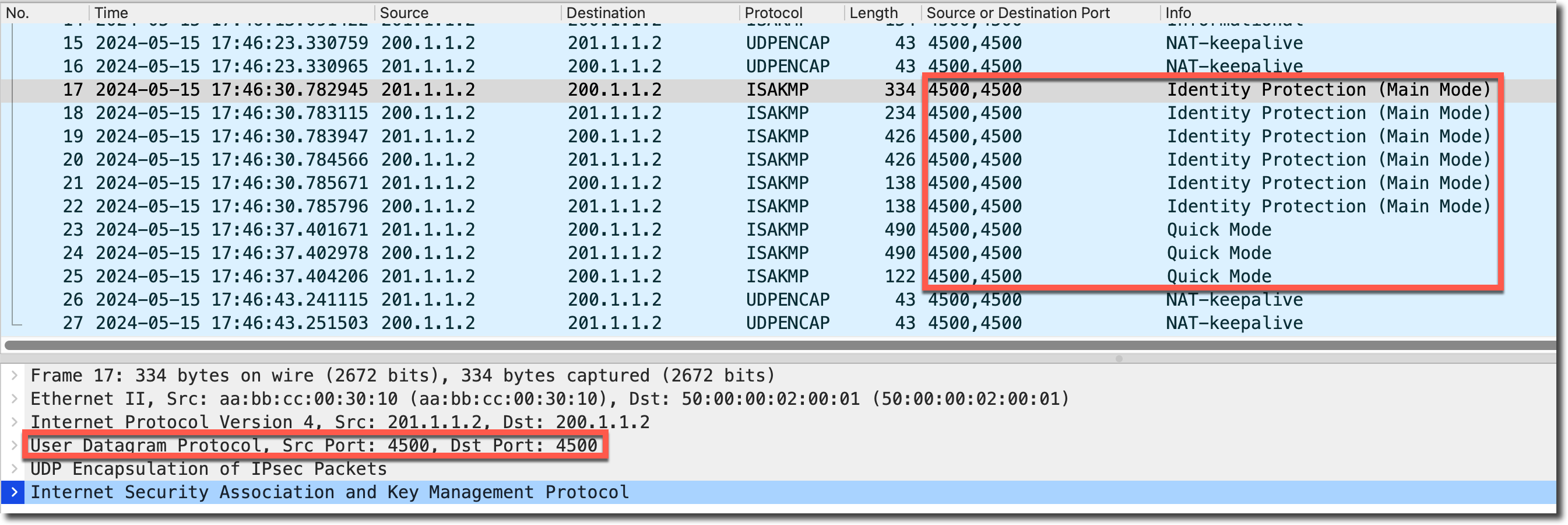
非 NAT-T:无论是 Rekey 方式还是新发起的 IKEv1 主模式协商,都是用 UDP 500 端口。
IKEv1 野蛮模式
FW2 的 SA soft-timeout 到期时发起的新的 SA 协商,新的 SA 协商正常使用 IKEv1 野蛮模式报文(一阶段 3 个包,二阶段 3 个包)交互,根据是否为 NAT-T 环境,Rekey 协商报文所使用的端口有所不同:
NAT-T:使用 Rekey 方式协商的 IKEv1 报文,所有协商报文将使用 UDP 4500 端口进行协商,报文内容不变。
重要
而新发起(非 Rekey 方式)的 IKEv1 野蛮模式协商第一阶段前 2 个报文使用 UDP 500 端口,最后 1 个报文才开始使用 UDP 4500 端口)。
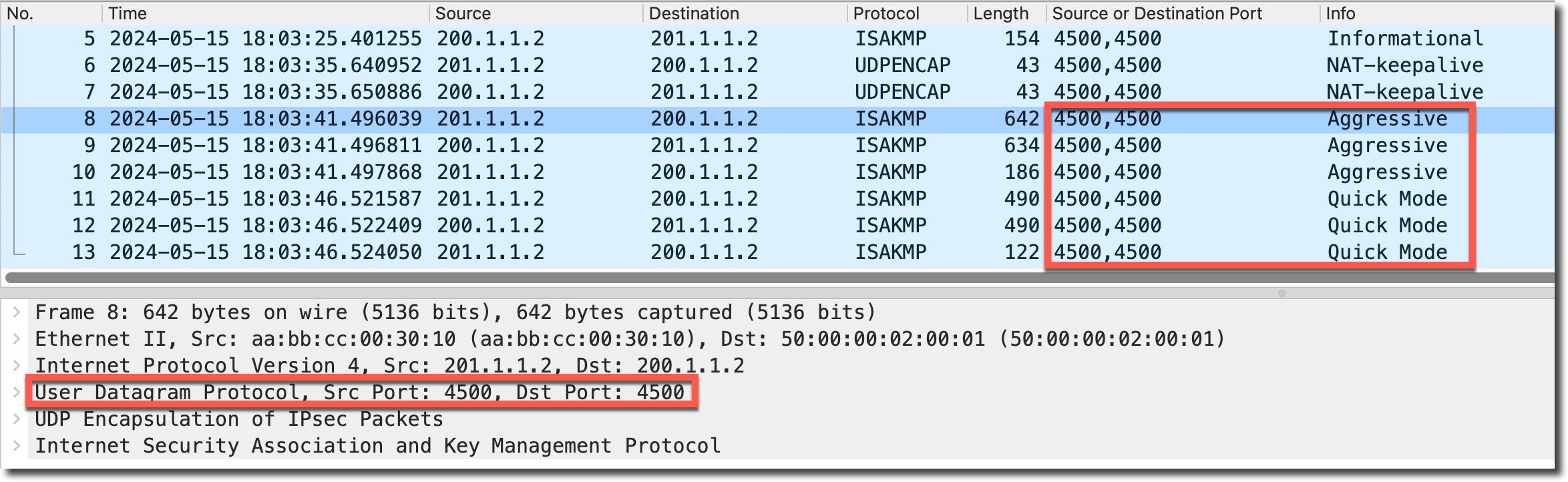
非 NAT-T:无论是 Rekey 方式还是新发起的 IKEv1 野蛮模式协商,都是用 UDP 500 端口。
IKEv2
FW2 的 SA soft-timeout 到期时发起的新的 SA 协商,新的一阶段 SA 协商包(原 IKE_SA_INIT)使用旧的一阶段 SA 进行加密/验证,使用 CREATE_CHILD_SA 封装发送,新的二阶段 SA 协商包(原 IKE_AUTH)使用新的一阶段 SA 进行加密/验证,使用 CREATE_CHILD_SA 封装发送。所以对于 IKEv2 的 Rekey 过程,均是被加密/验证保护的:
NAT-T:使用 Rekey 方式协商的 IKEv2 报文,所有协商报文将使用 UDP 4500 端口进行协商,报文内容不变。
重要
而新发起(非 Rekey 方式)的 IKEv2 协商 IKE_SA_INIT 的 2 个报文使用 UDP 500 端口,IKE_AUTH 的 2 个报文才开始使用 UDP 4500 端口)。
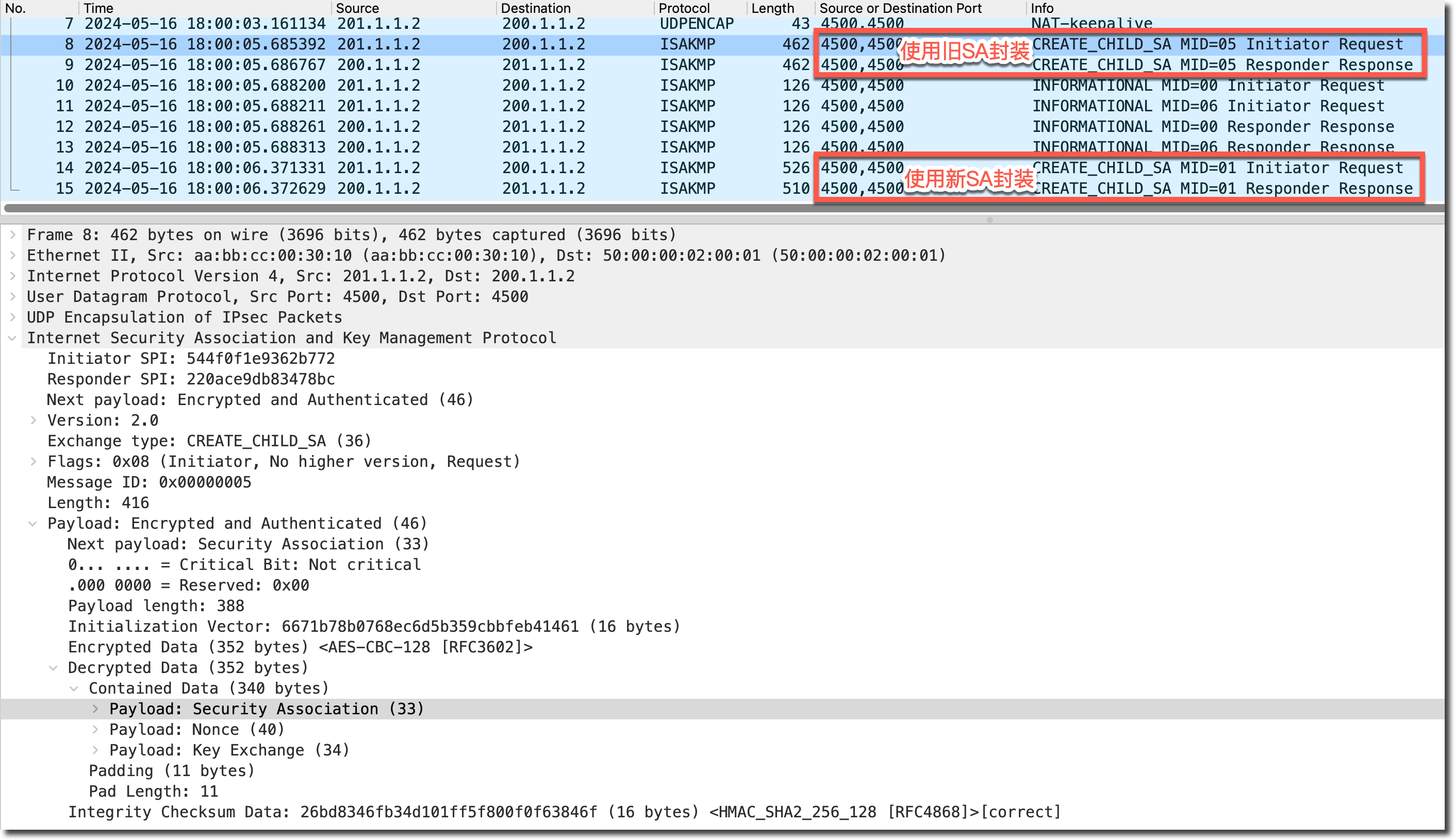
非 NAT-T:无论是 Rekey 方式还是新发起的 IKEv2 协商,都是用 UDP 500 端口。